
Following After Jesus Together: Prayer
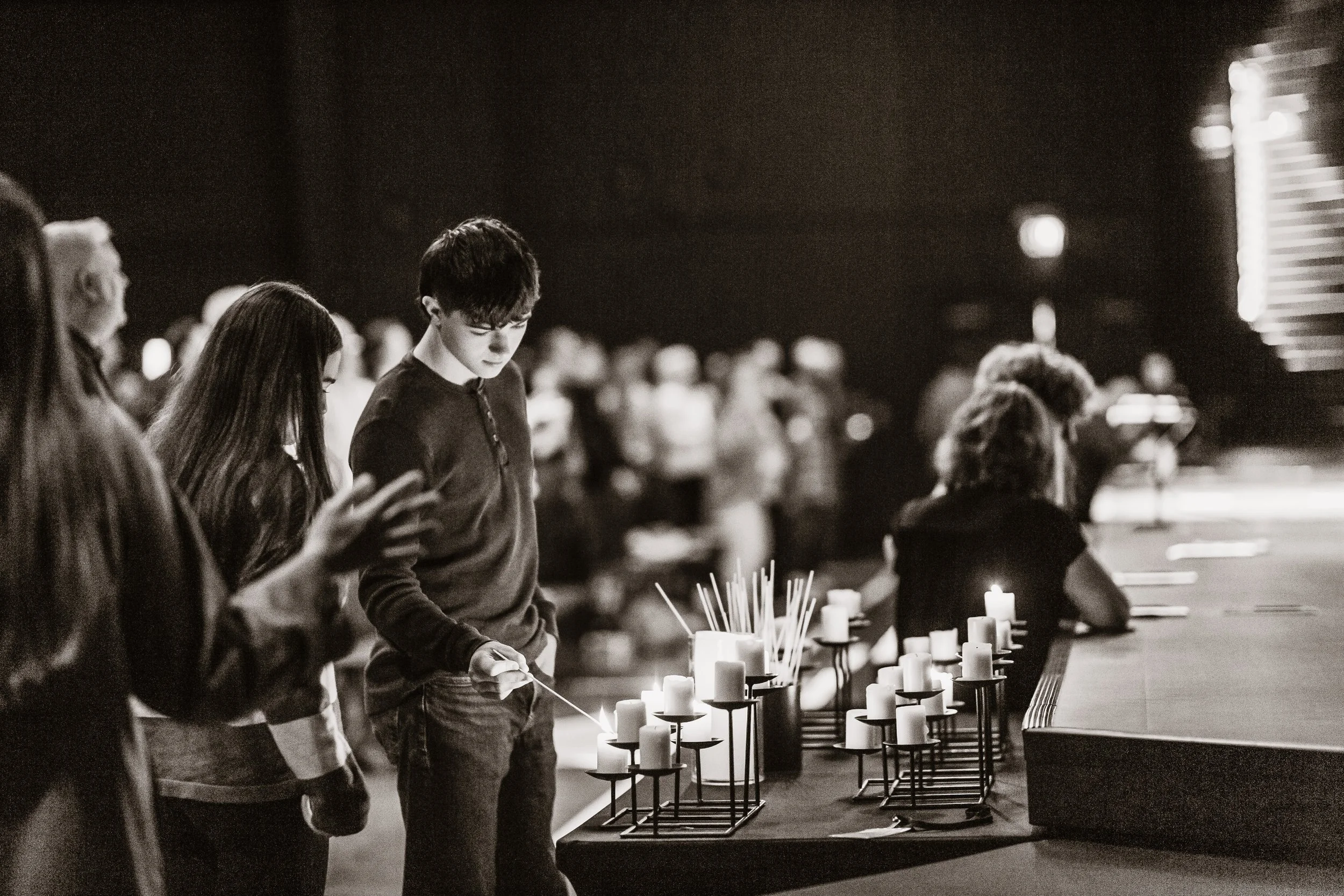
You know, it’s interesting… We don’t have an example in the Gospels of Jesus’ disciples asking Him to teach them leadership skills, preaching techniques, or how to perform miracles. The people who knew Him best didn’t ask him for what I would think are the most practical skills in ministry. They asked Him to teach them to pray.
There was something about the prayer life of Jesus that was so extraordinary that those who watched his life closest knew the way he prayed was the key to his power. They watched him preach. They watched him heal bodies. They watched demons obey him. They watched storms submit to him. They watched crowds gather around him. But, when they tried to understand where that kind of power came from, they traced it back to one place: Jesus kept disappearing to pray.
For Jesus, prayer wasn’t an escape from reality. It was a return to reality. The Father was His lifeline back to what was true. He would remove Himself from the noise, the crowds, the demands, the storms of life… and realign Himself with the Father.
But here is the elephant in the room when it comes to prayer: For a lot of us, part of the problem with prayer is God. Or maybe more accurately… the God we imagine is listening.
What do you think about when you think about God? Some of us imagine a disappointed God. An angry God. A God who is perpetually frustrated that we are not farther along than we are. Some of us honestly don’t know what to think.
But look at the way the Psalmist describes Him: “God is our refuge and strength, an ever-present help in trouble.” (Psalm 46:1 NIV) And then listen to the language Jesus uses:
“But when you pray, go into your room, close the door and pray to your Father, who is unseen.” (Matthew 6:6 NIV) Your Father… Jesus repeatedly uses that language. A good father knows the needs of his children. A good father doesn’t shun his children when they make mistakes. A good father teaches them. A good father wants them to come to him.
A few months ago, my daughter came to me with a problem: Another girl had been mean to her at school. This was the moment I had been waiting for. “No…” I said in astonishment. “Tell me more…” So she did. Apparently, a girl at school had told her that she was standing in the wrong place in line.
The audacity.
So, naturally, as her father, I was prepared to defend her honor. But I did feel compelled to ask one question: “Well… were you in the wrong place in line?” She was, in fact, in the wrong place in line. So we worked through it together. We talked about how to process it when somebody speaks to you in a way that feels mean. But we also talked about learning to ask another question besides:
“How did the way they talked to me make me feel?” Sometimes you also have to ask: “Were they right?”
As a father, I live for those moments. Not because I want my children to have problems, but because I want them to bring their problems to me. Because in those moments, I get to give them more than an answer. I get to teach them how to think. My hope as a father is that one day my children will not simply know: What would Dad do? I want them to understand: How does Dad think? What does he value? How does he see people? How does he process conflict? What does he believe is true? In other words, I don’t simply want to give them advice. I want to impart something of my character to them.
And this is part of what happens when we pray. We come to the Father. We bring Him our fear. Our confusion. Our wounds. Our desires. Our decisions… even our sin. And over time, something begins to happen: We don’t simply learn what God wants us to do; we begin to learn how our Father thinks. We learn what He loves. What He values. What He grieves. What He desires. When we pray, we align ourselves to the character and heart of the Father. And this Father is not merely loving. He is holy.
Jesus said: “…your Father knows what you need before you ask him. This, then, is how you should pray: ‘Our Father in heaven, hallowed be your name…’” (Matthew 6:8–9 NIV)
He’s our Father, and yet, hallowed be Your name. Near enough to call Father. Holy enough to worship. The God to whom we pray is not merely large enough to govern galaxies. He is near enough to inhabit the smallest details of a human life.
Martin Luther put it this way:
“Nothing is so small but God is still smaller, nothing so large but God is still larger…”
God is infinitely large and infinitely near. Infinitely loving and infinitely holy. He gives you the attention of a good Father… while remaining sovereign over the cosmos. And He doesn’t just tolerate you. He doesn’t just put up with you… He loves you.
We Need A Framework
I’m really gonna share my journey of prayer with you with as much honesty and vulnerability as I can.
In 2006, I first began to really intercede in prayer. I got a burden to pray for the freedom of a family member caught up in addiction. I felt drawn by God to go on walks every night. I was praying and fasting and interceding. That culminated in a wild journey of me and my best friend Tad doing a cross-country trip to take that family member to rehab. It was led by the Spirit of God and birthed in prayer. And this largely marked my prayer life.
I would pray when there was a need, but I wouldn’t say prayer was a constant in my life. I read Scripture. I went to church. I served and used my gifts. Callie and I tithed and gave. We fasted twice a year. We shared our table with people. But if I’m honest… there was something missing. I just couldn’t get my mind or heart around prayer. I prayed, but more in the sense of longing for connection.
Then in 2020, I had another crisis: The world shut down. As a pastor, I couldn’t gather people anymore. I was at a loss for what to offer the people other than a few instagram lives a week and some tips for bible study. I remember thinking, ”I wish we had more to offer.” It was around that time that I re-read The Contemplative Pastor by the late, great Eugene Peterson. This section cut me to my soul:
If I'm not busy making my mark in the world or doing what everyone expects me to do, what do I do? What is my proper work? What does it mean to be a pastor? If no one asked me to do anything, what would I do? … I can be a pastor who prays. I want to cultivate my relationship with God. I want all of life to be intimate - sometimes consciously, sometimes unconsciously - with the God who made, directs, and loves me. And I want to waken others to the nature and centrality of prayer. I want to be a person in this community to whom others can come without hesitation, without wondering if it is appropriate, to get direction in prayer and praying. I want to do the original work of being in deepening conversation with the God who reveals himself to me and addresses me by name. I don't want to dispense mimeographed hand-outs that describe God's business; I want to witness out of my own experience. I don't want to live as a parasite on the first-hand spiritual life of others, but to be personally involved with all my senses, tasting and seeing that the Lord is good. (Eugene, Peterson, The Contemplative Pastor: Returning to the Art of Spiritual Direction)
So I got a burden for prayer again. But this time, it wasn’t just to burn from time to time in prayer. It was to burn for the long run. For prayer to become the power center of my life.
So I began to read and study and look at church history and other traditions to see if there was another way to approach prayer. The only thing I knew was to try to pull myself up by my bootstraps and muster up a passion to pray. What I found was almost the opposite. What I actually needed was structure and a plan. A vision without a plan is a dream.
I want to give you a simple tool that you can use daily to create a framework, or a plan, for prayer. It’s simple and comes from the book How To Pray by Pete Greig. (10/10 recommend)
APPLICATION:
Take 10 minute a day this week, and follow this simple acronym:
P.R.A.Y.
Pause: Be still.
Rejoice: Rejoice in the Lord.
Ask: Present the needs.
Yield: Surrender control.
1. PAUSE
“Be still, and know that I am God...”
Why do we need to be still? Stillness readies the soul for actual communion with God. Silence wakes the soul to God’s presence.
Identify what brings you “stillness” and brings your soul to quiet. Be still and know…
2. REJOICE
“Rejoice in the Lord always…”
Speak out loud all the evidence of God’s love in your life. Rejoice. Memory is one of the greatest weapons against apathy. How do you combat the thought that maybe God’s not there? You bring evidence before the jury of your own mind of all the times that He was.
Name a few things, out loud if you can, which you are grateful to God for.
3. ASK
In The Lord’s Prayer, Jesus says: Come to the Father. Hallow His name… Then ask.
What do you need right now? Vision for your business? Patience with your children? Healing in your marriage? Soothing for a wounded conscience from sin?
Come boldly to the throne of grace and ask.
4. YIELD
What is God speaking to you? If you sense God speaking, make sure it conforms to His Word, the wisdom of His people, the leading of His Spirit, and lastly the circumstances He sets before you.
